Aniello Stellato
(documented in Naples, 1593 – 1648)
Pair of busts of Saint John the Evangelist and Saint Catherine of Alexandria
Carved, gilded, and polychromed wood/glass eyes
Maximum dimensions: h. 57 x w. 48 x d. 28 cm.
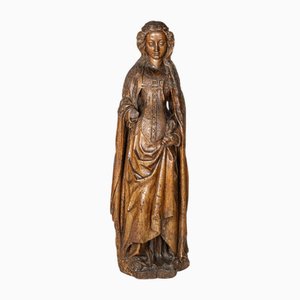
The pair of half-length sculptures offered here, in carved, painted, and gilded wood, are a fine example of early 17th-century Neapolitan sculptural art, and depict Saint John the Evangelist and Saint Catherine of Alexandria.
A perfect union of works of art, devotion, and luxury, they demonstrate the level of artistry and mastery achieved by Neapolitan carvers and the importance of their role in the cultural context.
The finish on the back, also entirely in gold leaf, attests that the two are part of a single installation commissioned by a very high patron. They were not intended to be placed in a niche, but displayed at the center of a Baroque altar, likely in a private chapel belonging to a noble family.
The juxtaposition of the two saints is far from coincidental, representing Divine Wisdom (John, the theologian among the Apostles) and Human Wisdom (Catherine, the Egyptian princess who used philosophy to convert pagan scholars), respectively, creating a profoundly meaningful pairing.
Geometric patterns on the gold leaf confirm that the work dates to the early decades of the 17th century, a period when Naples was a center of excellence for this art form.
Given the quality and unique workmanship, we are inclined to identify the stylistic signature of Aniello Stellato (and his workshop), an important sculptor active in the Kingdom of Naples between the late 16th and early 17th centuries. He was a master of carving and gilding, so much so that his contemporaries dubbed him the "god of wood" for his incredible skill in bringing life and movement to sacred statues.
Another detail of our works is the typical technique employed by 17th-century Neapolitan carvers, which included the insertion of glass eyes, an ingenious solution that made the sculptures incredibly realistic and seem "alive."
The geometric punching of the mantles highlights their distinctive quality: the sculptures were not simply liturgical objects, but true symbols of luxury, created for the altars of wealthy monasteries or private chapels of the nobility.
It should also be noted that the two busts, lacking the traditional reliquary case on their chests, represent independent devotional sculptures, supporting the hypothesis that they were created as part of monumental furnishings for private altars or important private collections. Without the requirement to include a relic, the artist also had greater freedom with the drapery, being able to sculpt the chest and robes without geometric interruptions to make room for the case.
As previously mentioned, the fact that the two statues are sculpted and gilded from top to bottom is a key detail that gives them great prestige: the aristocracy of the Spanish Viceroyalty in Naples loved to commission busts of patron saints from the great masters for their private altars and sacred collections.
ADDITIONAL INFORMATION:
The sculptures are in good condition, with some age-appropriate flaws that do not detract from their artistic value.
Sold with a certificate of authenticity and an iconographic .






























Get in Touch
Make An Offer
We noticed you are new to Pamono!
Please accept the Terms & Conditions and Privacy Policy
Get in Touch
Make An Offer
Almost There!
To follow your conversation on the platform, please complete the registration. To proceed with your offer on the platform, please complete the registration.Successful
Thanks for your inquiry, someone from our team will be in touch shortly
If you are a Design Professional, please apply here to get the benefits of the Pamono Trade Program